
Happiness is Only Real When Shared
How a dinner table question from my son got me thinking about 1000 acres in Montana

“Happiness is only real when shared.”
That line was written by Christopher McCandless — a man spending his final days alone in an abandoned bus in the Alaskan wilderness. He’d been living off the land for months, utterly isolated by choice, and by all accounts, he’d found what he went looking for: solitude, freedom, and a kind of raw, unmediated experience of the natural world.
And then, somewhere near the end, he wrote that line in the margins of a book.
The movie Into the Wild made the line famous. Probably one of the few instances where a movie was actually better than the book, this line from has become a bit of a family motto in our house.
It hits on something true and a little uncomfortable: you can chase everything you think you want, get it, and still come up empty if there’s no one to share it with.
Our kids are getting older. We’re having real conversations now — about the future, about life, about dreams and what they’d want their lives to look like. And the other day, one of them asked me a question I wasn’t expecting:
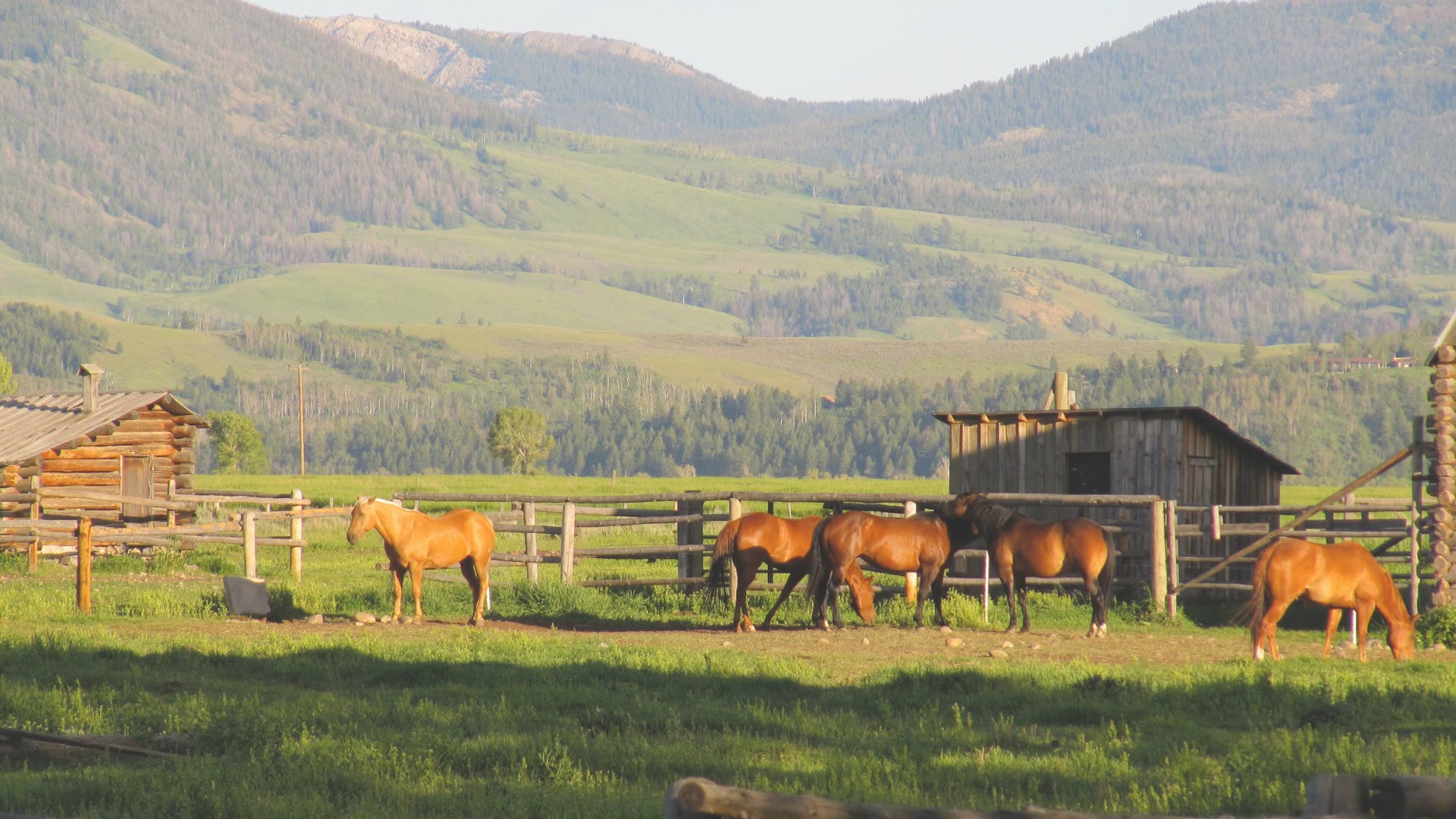
“Dad, would you rather own 1,000 acres in Montana... or 5 acres outside of Augusta?”
What a great question.
The Montana Fantasy
Let me be honest with you: on paper, 1,000 acres in Montana sounds extraordinary.
Wide open sky. Snow-capped mountains. Elk in the distance. Space in every direction. No neighbors, no traffic, no noise. Just land and quiet and the kind of freedom that most men spend their whole lives imagining.
I’ve seen enough hunting content and outdoor media to know how powerful that pull is. There’s something deep in the male psyche that responds to wide open space and the idea of complete self-sufficiency. The frontier instinct. The desire to be the man who carved something out of nothing, who answers to no one, who has room to breathe.
I get it. I feel it too.
But here’s the thing — and it took me a minute to put words to it when my kid asked:
Land is only as meaningful as the people you share it with.
One thousand acres where no one visits. No neighbors you know. No friends who stop by. No family within driving distance. No parish fifteen minutes down the road.
That’s not freedom. That’s isolation with a view.
What Five Acres Can Hold
Five acres near home — near here, near people — is a different kind of wealth entirely.
That’s Saturday cookouts that turn into four-hour conversations. That’s friends dropping in unannounced because they know they’re welcome. That’s your sons wrestling in the yard while you’re training in the barn. That’s grandparents close enough for Sunday dinners. That’s a church community you’ve built over years. That’s neighbors who know your name and whose kids grow up alongside yours.
None of that scales to a dollar amount. None of it shows up on a net worth statement. But I’d argue it’s a more accurate measure of a man’s wealth than acreage.
I’ve written before about the importance of guarding your time and what it reveals about your priorities. If your calendar reflects your values — and it does — then the question of Montana versus Augusta is really a question about what you’re actually building your life around. Because you can’t build real community from a distance. Community requires proximity. And proximity requires a choice about where you plant yourself.
The Trap of Scale
We live in a culture that is obsessed with scale.
Bigger house. More land. More followers. More money. More options. More everything.
And it’s not that any of those things are bad in themselves — I’m not arguing for poverty or smallness as virtues. Build the business. Train your body. Chase the dream. Stack the wins. None of that is the problem.
The problem is when we let the pursuit of more quietly pull us away from the people and places that make the more worth having in the first place.
Somewhere along the way, “successful” started to mean untethered. The man who can work from anywhere, live anywhere, answer to no one, belong to nothing. Maximum optionality. The fantasy of the person who has accumulated enough to need nobody.
But belonging to something — a community, a neighborhood, a parish, a family — is not a limitation. It’s the whole point.
The Catechism puts it plainly: “The human person needs to live in society. Society is not for him an extraneous addition but a requirement of his nature. Through the exchange with others, mutual service and dialogue with his brethren, man develops his potential; he thus responds to his vocation.” (CCC 1879)
It’s not that community is good for you the way vegetables are good for you — something you tolerate because it’s healthy. It’s that community is part of what you are. You don’t develop fully in isolation. The man who cuts himself off from meaningful relationship doesn’t become more himself. He becomes less.
Life Without Community Is a Quiet Kind of Poverty
I’ll say the thing plainly: life without community is a quiet kind of poverty.
You can have land, influence, status, followers, and money — and still be profoundly alone. And the people who have achieved the most outwardly are sometimes the most honest about this. The executive who built an empire and watched his kids grow up as strangers. The man who chased freedom his entire life and found silence instead of peace when he got there.
McCandless got it, unfortunately, too late.
The Catechism goes further in its teaching on solidarity — describing it not merely as a social nicety but as an eminently Christian virtue: “The principle of solidarity, also articulated in terms of ‘friendship’ or ‘social charity,’ is a direct demand of human and Christian brotherhood.” (CCC 1939)
Solidarity. Social charity. Brotherhood. These aren’t soft words. They’re describing something at the core of what a well-ordered human life looks like. And you can’t practice any of them at 1,000 miles from your nearest neighbor.
St. Thomas Aquinas, building on Aristotle, argued that man is by nature a social animal — not in the sense that we merely prefer company, but that we are constitutively ordered toward communion with others. We don’t just enjoy community; we need it to flourish. The hermit’s life is a rare vocation, not the default ideal. Most of us were made for the noise of children in the yard and the disruption of a friend who shows up uninvited.
What I Told My Son
I answered my son honestly.
I’d take the five acres near home. Without hesitation.
Not because Montana isn’t spectacular. It is. Not because I don’t feel the pull of wide open space. I do.
My kids and I like to jokingly sign that line from an old Marty Robbins song, “I’ve got a hundred and sixty acres in the valley, a hundred and sixty acres that I love”. I’d love some acreage to roam and cultivate. But I’d choose a smaller tract close by because I want to optimize rootedness and relationship.
I want to build something close. I want to choose depth of place over breadth of acreage.
Build It Close Enough to Share
I’ve been thinking lately about the men I most respect — and trying to identify what they have in common. It’s not income, or land, or platform size. It’s that they built something worth coming home to. They have people around them. They matter to a specific set of real people who would notice if they were gone. The best men I know married well, chose their communities carefully, and put down roots that held when things got hard.
That’s not a small thing. That’s the whole thing.
Discipline that includes physical training, habits, mental fortitude — none of it is an end in itself. It’s preparation for something. For the demands of real life, real responsibility, real relationship. A man who trains hard and builds well, but builds alone, has missed the point.
Build the business.
Train the body.
Chase the dream.
But build it close enough to share.
Because happiness — real happiness — isn’t found in how much ground you own.
It’s found in who’s standing on it with you.