
On Doing Real Things
Why stepping away from constant digital noise makes room for presence, interruption, and the moments we actually remember.


I’m Not Anti-Technology
I love technology.
It opened the doors for my career, paved the path for my work as a consultant and entrepreneur, and still powers much of my professional life.
But it’s also become dangerously easy to stay there—to spend the majority of one’s waking life behind the soft glow of a blue-lit screen.
So much so that even when you’re “offline,” you’re still being pulled by it. Every ding, ping, and ring from the device tethered to your body like an extra appendage quietly robs you of your presence in the moment.
When the Digital World Never Lets Go
The distractions and easy dopamine hits from your notifications often provide a simpler source of entertainment or pleasure than the lulls of the real world.
On-demand environments, ready to cater to your every attentional need, curiosity, or desire, make the physical world—which doesn’t readily bend over to meet those needs—seem dull, boring, or “too slow.”
And that constant pull from the digital universe impacts our ability to simply be present with those around us, to experience the unplanned moments that often lead to meaningful conversations, personal interactions, and lasting memories.
The Question We Don’t Like to Ask
How many memorable moments have we missed by being tethered to the digital worlds in which we spend most of our waking time?
If we’re honest: probably more than we’d like to admit.
It pains me to admit that there have been moments when in life where I’m at home, sitting at the kitchen counter, or in the living room, and one of my kids comes into the room.
They’re talking to me about something important to them—a lego creation, a book they read, an adventure they had. They finish their story and look up at me only to see a blank stare. I wasn’t listening. I was caught up in thought about some notification, email, or message I received and I realize I wasn’t listening at all.
A Line in the Sand
At some point, reflection has to turn into action.
For me, that meant deciding to stop letting the digital world claim every unguarded moment by default—and to be more intentional about how I spend my time when work is done.
I still live online for work. That isn’t changing. But I no longer want screens to be the automatic answer to every quiet moment, every evening lull, every gap in the day.
Instead, I’ve been choosing more analogue forms of entertainment and hobbies—activities that slow me down rather than speed me up.
The first evening I tried it out, the temptation to reach down and look at my phone came in full force. I didn’t realize how much of a habitual behavior looking at that glow screen was. I even experienced “phantom vibrations”—you know, that feeling where you’re sure it’s your phone vibrating in your pocket.
But, over the past few weeks, I’ve become more comfortable sitting in silence, feeling bored (or simply not overstimulated), and not doing anything to fix it.
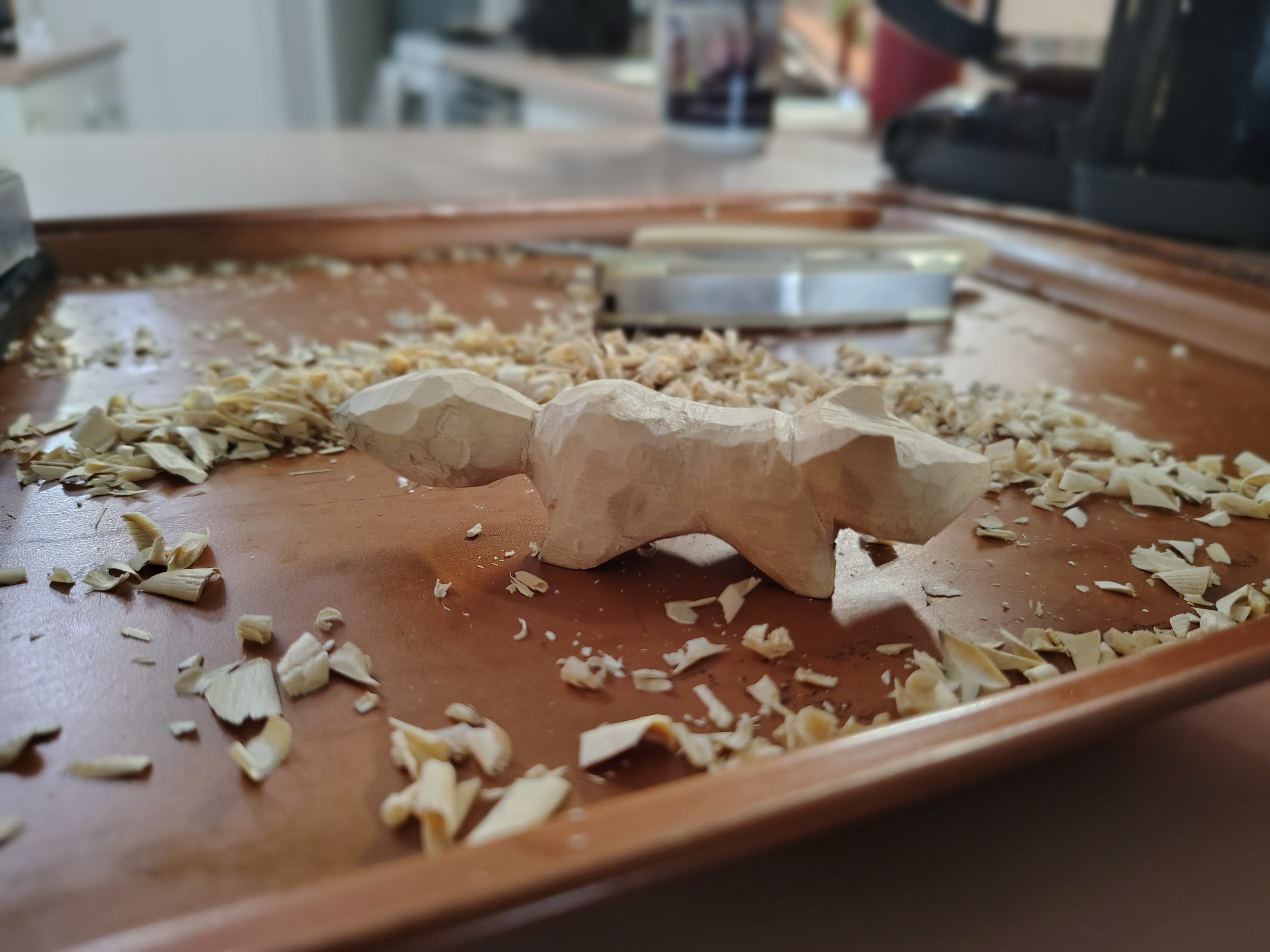
Lately, that’s meant playing chess with my kids in the evenings, reading physical books before bed, and even picking up whittling as a new-found hobby.
What Working With Your Hands Does to You
There’s something instructive about working with your hands again.
No notifications. No optimization. No audience.
Just a block of wood, a sharp edge, and time.
Whittling reminds you that not everything worth doing needs to be efficient, scalable, or shared. Progress is slow. Mistakes are visible. And the only way forward is presence—paying attention to grain, pressure, and patience.
And maybe more importantly, it creates space for interruption.
When your hands are busy and your phone is out of reach, you notice things you’d otherwise miss. A child wanders in with a question. A conversation starts and goes somewhere unexpected. Silence stretches just long enough to become meaningful.
Those moments don’t announce themselves with pings or banners. They can’t be scheduled or optimized. They only happen when you’re actually there—available to be interrupted.
The small figure on my desk didn’t exist an hour earlier. It wasn’t downloaded. It wasn’t suggested by an algorithm. It came into being through attention and effort in the real world.
And so did the moments that happened around it.
Less Glow. More Grain
The digital world isn’t evil—but it is loud. It fills every empty space if you let it.
The analogue world, by contrast, leaves room.
Room for friction.
Room for distraction.
Room for memory.
It doesn’t demand constant attention or promise instant reward. It simply waits—until you show up.
So I’m choosing to leave more space unfilled.
Less passive consumption.
More deliberate creation.
Less glow.
More grain.
Not because technology is bad—but because the moments we remember most are rarely planned, rarely efficient, and almost always found in the interruptions we were present enough to allow.